


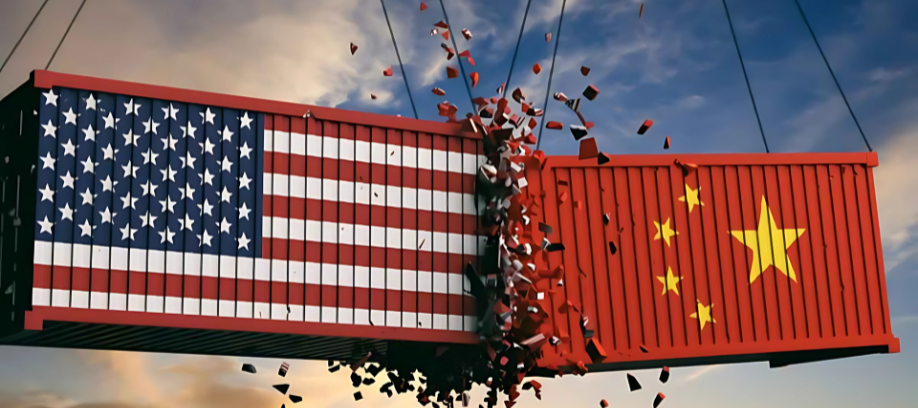
China Strives for 5% Growth Amid Trade Tensions with the U.S.
Economic Growth Targets and Policy Announcements
China has set an ambitious economic growth target of “around 5%” for this year, committing to inject billions into its struggling economy. This comes amid increasing trade tensions with the United States, exacerbated by a fresh round of tariffs.
During the National People’s Congress, an annual meeting attended by thousands of delegates, leaders unveiled their economic roadmap. While largely a rubber-stamp parliament, the gathering is closely analyzed for insights into Beijing’s policy shifts, making this year’s meeting particularly significant.
Technological Progress and Global Interest
Chinese state media has highlighted advancements in the technology sector, showcasing companies like DeepSeek and Unitree Robotics as examples of the country’s “technological progress.”
DeepSeek’s recent success, in particular, led to an AI-driven stock rally, signaling a resurgence of interest from foreign investors. A commentary in state-run Xinhua underscored China’s push for sustainability, stating, “China’s new energy industries and overall green transition, driven by its cutting-edge technologies, will continue to be important growth drivers.”
Impact of U.S. Tariffs on China’s Economy
Despite these advancements, China’s economic aspirations face significant hurdles. New tariffs from the U.S. compound the trade barriers already established during Donald Trump’s presidency.
Economic analyst Harry Murphy Cruise warns of the adverse effects of these policies, stating, “The chaos that tariffs leave in their wake is kryptonite for investment. Tariffs are set to deliver a one-two punch to China’s economy, landing blows to both exports and investment.”
Defense Budget and Economic Challenges
Amid economic challenges, China has also announced a 7.2% increase in its national defense budget, maintaining the same growth rate as last year. President Xi Jinping’s administration was already grappling with weak consumer spending, a property sector crisis, and rising unemployment before the latest U.S. trade measures took effect.
As of Tuesday, a new 10% levy on Chinese imports was implemented, following another 10% tariff introduced in February. This has raised the total U.S. tariff burden to 20%, targeting one of China’s few economic bright spots—exports.
China’s Retaliatory Measures
China swiftly responded to the U.S. tariffs by imposing retaliatory levies of 10%-15% on select American agricultural imports. As one of the largest buyers of U.S. agricultural goods—including corn, wheat, and soybeans—China’s countermeasures are expected to have a significant impact on American farmers.
At the opening of the Two Sessions meeting, Chinese officials reiterated their commitment to making domestic demand the “main engine and anchor” of economic growth. While China successfully achieved its 5% target over the past two years, much of that success was driven by strong exports, which resulted in a nearly $1 trillion trade surplus. However, replicating that performance in the face of trade restrictions will be far more challenging.
Murphy Cruise predicts that “if the tariffs linger, Chinese exports to the U.S. could drop by a quarter to a third.” This underscores the urgency for China to stimulate domestic consumption.
Government Initiatives to Boost Domestic Demand
Premier Li Qiang acknowledged that domestic consumption remains sluggish, pledging to “vigorously boost” household spending. “Domestically, the foundation for China’s sustained economic recovery and growth is not strong enough,” he admitted.
To encourage spending, the government has introduced schemes allowing consumers to trade in and upgrade household appliances, vehicles, and electronic devices. Additionally, Beijing aims to increase disposable income and reduce dependence on exports and investment.
To support these initiatives, China plans to issue 1.3 trillion yuan ($179 billion) in special treasury bonds for stimulus measures. Local governments will also be permitted to raise borrowing limits to 4.4 trillion yuan, up from last year’s 3.9 trillion yuan, as outlined in the annual “Work Report.”
Fiscal Policy Adjustments and Employment Targets
In a rare move, China raised its fiscal deficit target by one percentage point to 4% of GDP—the highest level in decades—signaling a willingness to increase spending to sustain growth. Traditionally, Beijing has maintained a deficit cap of 3% to demonstrate fiscal prudence.
The government has also set a goal of creating more than 12 million urban jobs while keeping the unemployment rate around 5.5% for 2025, a slight increase from last year’s 5.1%.
Future Prospects and Challenges
Despite government intervention, a key concern remains whether these measures will effectively drive consumption. The lingering effects of strict pandemic-era policies, an ongoing real estate crisis, and regulatory crackdowns on tech and finance industries have weakened consumer confidence. Moreover, China’s limited social safety net has led many citizens to prioritize savings over spending.
Nevertheless, officials remain optimistic. CPCC spokesman Liu Jieyi remarked, “While the economy is facing challenges such as low demand, it is important to recognize that China’s economic fundamentals are stable, there are many advantages, resilience is strong, and potential is significant.”
Focus on High-Quality Development
President Xi has emphasized “high-quality development,” a strategy aimed at advancing high-tech industries, including renewable energy and artificial intelligence. As the world’s second-largest economy, China continues its long-term goal of reducing reliance on Western technology and cementing itself as a global leader in innovation.
With trade tensions persisting and economic challenges mounting, the success of China’s policies in stimulating domestic growth while navigating external pressures will be crucial in determining whether it can meet its 5% growth target in the coming year.



0 Comments