


OpenAI Unveils ChatGPT Pulse: Personalized Morning Briefs for Busy Professionals
A New Way to Start the Day
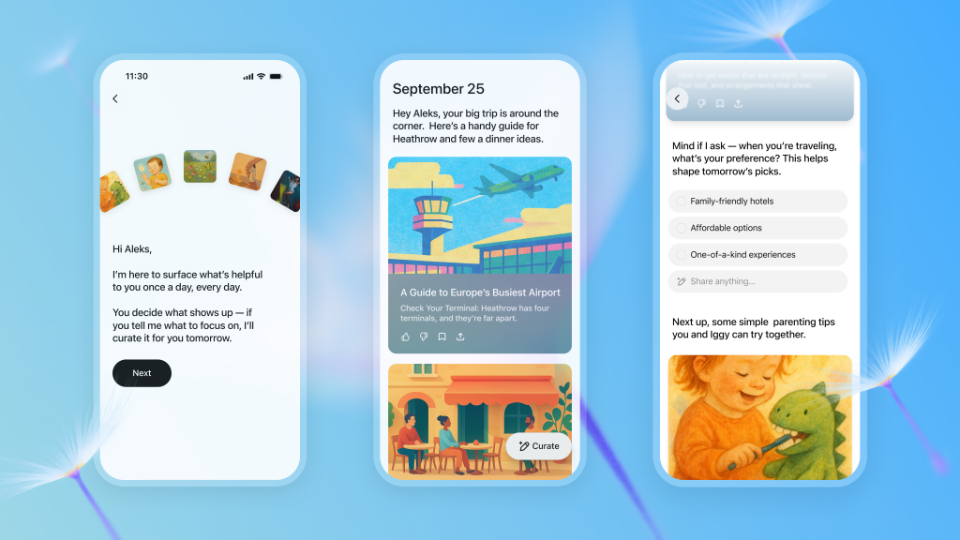
OpenAI has announced the launch of ChatGPT Pulse, a new feature designed to deliver personalized daily reports while users sleep. Instead of waking up to social media feeds or traditional news apps, Pulse provides five to ten tailored briefs to help professionals start their day informed and organized.
This initiative signals a broader shift in OpenAI’s approach: moving ChatGPT from a reactive chatbot to a proactive digital assistant.
Shaping AI Into a Personal Assistant
Recent product developments — including ChatGPT Agent and Codex — reflect OpenAI’s ambition to build tools that work asynchronously for users. Pulse, in particular, is meant to anticipate user needs, reducing the friction of having to ask questions each time.
“We’re building AI that lets us take the level of support that only the wealthiest have been able to afford and make it available to everyone over time,” explained Fidji Simo, OpenAI’s new CEO of Applications, in a company blog post. “And ChatGPT Pulse is the first step in that direction — starting with Pro users today, but with the goal of rolling out this intelligence to all.”
Exclusive to Premium Subscribers — For Now
As with other compute-intensive services, Pulse will initially be available only to subscribers of OpenAI’s $200 per month Pro plan, launching as a new tab inside the ChatGPT app.
CEO Sam Altman recently acknowledged that limited computing infrastructure is driving such exclusivity. OpenAI has admitted it faces severe server constraints and is expanding capacity by partnering with firms like Oracle and SoftBank to build AI data centers.
While Plus subscribers are expected to gain access soon, OpenAI says it must first optimize the efficiency of Pulse before rolling it out more widely.
What Pulse Can Do
Pulse reports can cover anything from industry news roundups to personalized itineraries. In a demo for TechCrunch, OpenAI product lead Adam Fry shared examples, including:
-
A news digest on the British football team Arsenal.
-
Halloween costume ideas for his family.
-
A toddler-friendly travel plan for Sedona, Arizona.
Reports appear as interactive “cards” featuring AI-generated images and summaries. Users can click through for full reports, query ChatGPT for deeper context, or request new reports.
Interestingly, Pulse has a built-in limit — once it generates a set of briefs, it ends with the message “Great, that’s it for today.” According to Fry, this was a deliberate choice to distinguish Pulse from engagement-driven social media platforms.
Integration With Everyday Tools
Pulse connects seamlessly with ChatGPT Connectors, allowing it to integrate with Google Calendar, Gmail, and other apps. This makes it possible to:
-
Highlight urgent emails overnight.
-
Provide a calendar-based daily agenda.
-
Suggest dinner reservations or even tailor menus to personal dietary needs.
If ChatGPT memory is enabled, Pulse also adapts to long-term user habits. For instance, personalization lead Christina Wadsworth Kaplan noted that Pulse learned her passion for running and automatically added jogging routes to her London travel plans. It even accounted for her pescatarian diet when suggesting restaurants.
Kaplan described Pulse as “net-new functionality” for consumer AI — a shift toward deeply personal, context-aware support.
Competition With News Providers
While Pulse cites its sources much like ChatGPT Search, its ability to aggregate, synthesize, and personalize could make it a competitor to platforms like Apple News, paid newsletters, and traditional journalism outlets.
Still, Fry downplayed direct competition, suggesting Pulse complements rather than replaces existing news apps.
The Question of Efficiency
One of the key challenges lies in the computational cost. Fry admitted that Pulse’s efficiency varies dramatically: some reports are lightweight, while others require extensive web searches and synthesis of documents.
The question remains whether the feature justifies the heavy computing power required — especially as OpenAI balances demand against infrastructure limits.
The Road Ahead
Looking forward, OpenAI hopes to make Pulse more agentic — capable of taking actions like booking reservations or drafting emails for user approval. However, such functionality will depend on further advancements in trust and reliability of AI models.
For now, Pulse represents a strategic milestone in OpenAI’s vision of transforming ChatGPT into an indispensable digital assistant, bringing concierge-style support to professionals everywhere.




0 Comments