


Tech Education from the Ground Up
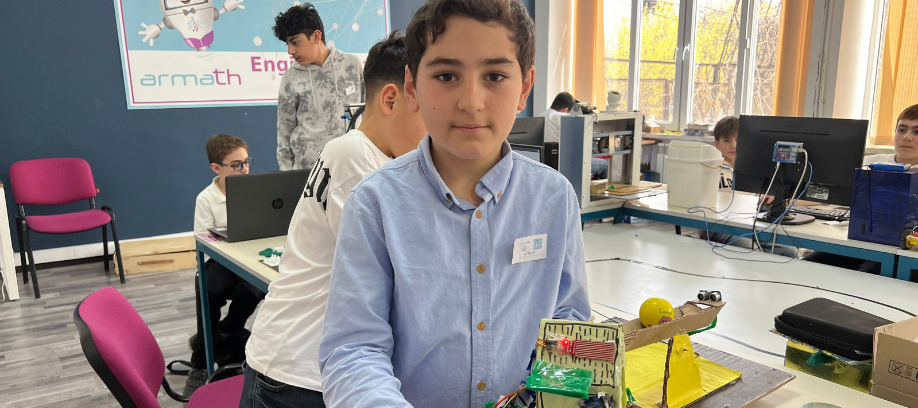
In the outskirts of Yerevan, Armenia’s capital, the future of the country’s tech sector is taking shape—quite literally—in the hands of its youngest citizens. Inside a modest three-storey school building, nine-year-old Slavik proudly showcases a homemade gadget featuring three LED lights.
“He has learned how to control it, and the programming language. You can see the code is written by him,” explains Maria, a 21-year-old coach guiding the young tech enthusiasts.
Elsewhere in the classroom, teenagers Eric and Narek are presenting a smart greenhouse controlled by a mobile app, while 11-year-old Arakel beams as he demonstrates a cardboard model of a home complete with a motorised retractable clothesline. “I have made my mother’s work easy… when it rains the line goes under the roof to keep the clothes dry,” he says.
These students are participants in Armath, an after-school programme launched in 2014 that introduces children to skills like coding, robotics, 3D modeling, and app development. As of today, there are 650 Armath engineering labs operating throughout Armenian schools.
A Vision Backed by Industry
Armath is spearheaded by the Union of Advanced Technology Enterprises (UATE), an industry body representing over 200 Armenian high-tech firms. According to Sarkis Karapetyan, UATE’s CEO, the programme aims to cultivate a tech-savvy generation that can help Armenia become a global innovation hub.
“The vision is that we want to see Armenia becoming a tech centre powerhouse that delivers utmost values to Armenia and to the world,” Karapetyan says.
From his Yerevan office, Karapetyan shares how the initiative thrives on a hybrid model of private-public partnership. “We raise capital expenditure from the private sector, we go to the schools and establish Armath labs, we donate the equipment,” he explains. “And the government, the education ministry gives us a budget of $2 million annually to pay the salaries of the coaches.”
Currently, more than 600 coaches are engaged in the programme, teaching over 17,000 active students. UATE’s goal? “To have 5,000 of the most talented kids decide to become engineers every year.”
A Country with Legacy—and Limitations
Armenia, a landlocked country of 2.7 million, has long faced geopolitical and economic hurdles. Its borders with Azerbaijan and Turkey remain closed due to unresolved disputes, and unlike some of its neighbours, Armenia lacks natural resources.
However, the country is drawing upon its Soviet-era reputation for excellence in mathematics and computing. The Yerevan Scientific Research Institute of Mathematical Machines, founded in 1956, developed two early-generation computers by 1960. This scientific legacy now forms the backbone of Armenia’s modern digital ambitions.
Startups Making a Global Mark
The results are already visible. Armenian-founded Picsart, an AI-powered photo and video editing platform, has become a global success, valued at $1.5 billion and headquartered in both Yerevan and Miami.
Other notable Armenian startups include Krisp, a noise-canceling software provider, and Service Titan, a cloud-based software platform for the home services industry, recently valued at over $10 billion after its IPO on the New York Stock Exchange.
According to an annual global business report, Armenia ranks 57th worldwide as the best place to start a business—outpacing its neighbours Georgia (70th) and Azerbaijan (80th).
The Armenian Diaspora: A Strategic Advantage
A significant driver of Armenia’s tech momentum is its vast global diaspora. Roughly 75% of Armenians live outside the country, forming a well-connected global network, particularly strong in the United States, where 1.6 million Armenian-Americans live, mostly in California.
Samvel Khachikyan, programme director at SmartGate, a dual-based venture capital firm in California and Armenia, says these global ties provide essential support for startups. “If you look at the top 500 companies in the US, for sure you’ll find at least one or two Armenians,” he notes.
SmartGate helps Armenian founders establish a foothold in Silicon Valley through mentorship and networking. “It’s like the launch of the rocket, the first couple of seconds is the hardest,” Khachikyan adds.
Testing Locally, Scaling Globally
Many Armenian tech firms start by piloting their solutions in the domestic market. One example is Dr Yan, a healthtech app founded by Irina Ghazaryan, which simplifies the process of booking doctor appointments. “Patients couldn’t find the right doctors, and doctors were suffering from endless calls,” says Ghazaryan.
The app, which charges doctors a subscription fee to be listed, is seeing rapid growth. “We are growing at least 25% revenue month by month. We are almost break-even in Armenia and that gives us strength to start expanding to other markets, like Uzbekistan.”
Russian Migration Boosts Armenia’s Tech Workforce
In 2022, Armenia’s tech ecosystem experienced an unanticipated surge when thousands of Russian IT professionals fled their home country following the invasion of Ukraine. Many of them settled in Armenia, including large corporations like Nvidia, which relocated its Russian operations to Yerevan.
Vasily, a Russian IT consultant who moved to Armenia in 2023, estimates the influx of Russian tech workers is between 5,000 to 8,000. “Armenia was the most friendly to people from Russia in order to help them move, adapt and so on,” he says.
The arrival of skilled Russian professionals has filled critical gaps in areas such as cybersecurity, fintech, and data science. Still, Vasily warns of rising costs: “Armenia can be expensive, and the country needs to reduce the tax burden on IT firms if it wants them to stay.”
Looking Ahead
Despite economic and geopolitical limitations, Armenia is rapidly positioning itself as a serious player in the global tech arena. With a strong foundation in STEM education, a well-connected diaspora, and an influx of international talent, industry experts like Khachikyan remain bullish.
With more success stories like Service Titan on the horizon, the vision of Armenia as the “Silicon Valley of the Caucasus” seems increasingly within reach.




0 Comments