


The Race to Own the AI Software Layer: How Osaurus Is Betting on Local Intelligence
Cyprus Business Group | Technology & Innovation
As artificial intelligence models grow more widespread and interchangeable, the real competitive battleground is shifting — away from the models themselves and toward the software that controls them. A new generation of startups is moving quickly to claim that territory, building intelligent control layers that sit above the raw AI and give users a smarter, more flexible experience. One of the most intriguing new entrants in this space is Osaurus, an open-source AI server built exclusively for Apple hardware, which allows users to switch seamlessly between local and cloud-hosted AI models while keeping their personal data, files, and tools firmly under their own control.
From a Digital Companion to a New Category
Osaurus did not emerge from a boardroom strategy session — it grew out of a conversation with customers. The project traces its origins to an earlier product called Dinoki, a desktop AI companion conceived by Osaurus co-founder Terence Pae as a kind of modern, AI-powered version of Microsoft’s old Clippy assistant. During that phase, Pae noticed a recurring complaint: users were reluctant to pay for the app on top of the token costs already charged by AI providers — the usage units that cloud AI companies levy for processing queries and generating responses.
That friction planted a seed. If users resented paying twice, what if the AI ran entirely on their own machine?
“That’s how Osaurus started,” Pae, a former software engineer at both Tesla and Netflix, explained. “The idea was to try to run an AI assistant locally. You can do pretty much everything on your Mac locally, like browsing your files, accessing your browser, accessing your system configurations. I figured this would be a great way to position Osaurus as a personal AI for individuals.”
Pae developed the tool transparently, building it as an open-source project and iterating in public, adding capabilities and addressing issues with community input along the way.
What Osaurus Actually Does
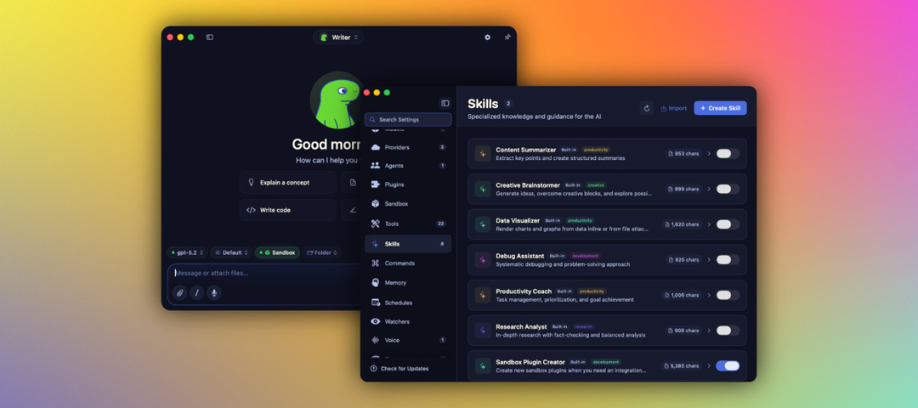
At its core, Osaurus functions as what the technology industry calls a “harness” — a unified control layer that connects multiple AI models, tools, and workflows through a single interface. In practice, this means users can plug in locally hosted models or connect to cloud-based providers such as OpenAI and Anthropic, then switch between them depending on the task at hand. Because different models excel at different things, the ability to move fluidly between them is a meaningful practical advantage.
Similar tools exist — OpenClaw and Hermes among them — but they are primarily aimed at technically proficient users comfortable working in a command-line environment. Some, like OpenClaw, have also attracted criticism for potential security vulnerabilities.
Osaurus takes a different approach. It presents a consumer-friendly interface accessible to non-developers, and tackles security concerns by operating within a hardware-isolated virtual sandbox — a contained environment that limits what the AI can access, protecting both the user’s machine and their data.
Currently, Osaurus supports a broad range of models including MiniMax M2.5, Gemma 4, Qwen3.6, GPT-OSS, Llama, and DeepSeek V4, among others. It also integrates with Apple’s on-device foundation models and Liquid AI’s LFM family of edge models. On the cloud side, it connects to OpenAI, Anthropic, Gemini, xAI/Grok, Venice AI, OpenRouter, Ollama, and LM Studio.
As a full MCP (Model Context Protocol) server, Osaurus can also grant any compatible client access to the user’s tools. It ships with over 20 built-in plugins spanning Mail, Calendar, Vision, macOS system controls, XLSX, PPTX, Browser, Music, Git, Filesystem, Search, and more — and has recently added voice capabilities.
The Hardware Reality of Running AI Locally
Running AI models on personal hardware is still in its early stages and carries real demands. To operate local models, a system requires a minimum of 64 GB of RAM. For larger models such as DeepSeek V4, Pae recommends machines with approximately 128 GB of RAM — specs that currently put the technology out of reach for most consumer hardware.
Osaurus competes in this space alongside tools including Ollama, Msty, and LM Studio, though it differentiates itself through its broader feature set and its ambition to serve non-technical users as well as developers.
Yet Pae is confident that the resource requirements will diminish over time, as the economics of local AI follow their own improvement curve.
“I can see the potential of it, because the intelligence per wattage — which is like the metric for local AI — has been going up significantly. It’s on its own curve of innovation. Last year, local AI could barely finish sentences, but today it can actually run tools, write code, access your browser, and order stuff from Amazon […] it’s just getting better and better,” he said.
Traction and the Road Ahead
The numbers suggest early momentum. Since launching less than a year ago, Osaurus has been downloaded more than 112,000 times, according to figures published on its website.
Pae and co-founder Sam Yoo are currently participating in the Alliance accelerator programme, based in New York. Looking ahead, the team is exploring enterprise applications — particularly in sectors such as legal services and healthcare, where running AI models on local infrastructure could address significant data privacy concerns that make cloud-based solutions problematic.
On a broader level, the Osaurus team believes that the maturation of local AI could ease the industry’s growing dependence on vast, energy-hungry data centres.
“We’re seeing this explosive growth in the AI space where [cloud AI providers] have to scale up using data centers and infrastructure, but we feel like people haven’t really seen the value of the local AI yet,” Pae said. “Instead of relying on the cloud, they can actually deploy a Mac Studio on-prem, and it should use substantially less power. You still have the capabilities of the cloud, but you will not be dependent on a data center to be able to run that AI.”
Why This Matters for Business
For business leaders watching the AI landscape, the Osaurus story illustrates a wider trend: the competitive advantage in AI is increasingly about orchestration, not raw intelligence. As foundation models become cheaper and more similar in capability, the tools that connect, manage, and personalise those models stand to capture significant value.
For organisations — whether in Cyprus or globally — considering AI adoption, the emergence of tools like Osaurus raises important strategic questions. How much does your organisation value data sovereignty? What is the total cost of cloud AI at scale versus an on-premise alternative? And as local AI capabilities continue to accelerate, which approach positions you best for the years ahead?
These are questions worth asking now, before the answers become obvious in hindsight.
References & Further Reading
- Osaurus Official Website
- Osaurus on GitHub (Open Source Repository)
- Dinoki AI — The Predecessor Project
- Terence Pae on LinkedIn
- Ollama — Local Model Runner
- LM Studio — Local AI Desktop App
- Msty — Getting Started Guide
- OpenClaw Coverage — TechCrunch
- Hermes Agent on GitHub
Cyprus Business Group covers technology, innovation, and business strategy for the professional community in Cyprus and the wider region.




0 Comments