


Memory Costs Are Rising. Here’s How Savvy Businesses Are Staying Ahead
Cyprus Business Group | Technology & Innovation
If your organisation has been pricing up hardware recently — whether for workstations, servers, or employee computing — you have likely noticed that system memory is no longer the affordable line item it once was. A system that would have cost €1,000 two years ago now commands €1,300 to €1,400 before a single specification upgrade is made. Understanding why this has happened, and what it means for procurement strategy, is increasingly important for technology buyers across every sector.
Why RAM Prices Have Surged — and Why It’s Not Temporary
The primary driver behind rising memory costs is the explosive global investment in artificial intelligence infrastructure. Training and operating large AI models demands enormous quantities of a specialised type of memory known as high-bandwidth memory (HBM). The manufacturers producing HBM are the same facilities that supply the standard DDR RAM used in everyday computing — and when major hyperscalers including Google, Microsoft, and Amazon arrived with large-scale contracts, memory producers faced a straightforward commercial decision.
Namanh Hoang, Director of Branding and Marketing at CyberPowerPC, described the impact plainly: “The industry really wasn’t prepared for that type of shock. AI came on us quickly, and the rate of acceleration was well beyond expectations. Hyperscalers started investing so much, so suddenly into infrastructure, it consumed a huge portion of the factory capacity for producing consumer memory, and building more factories to meet demand will take a lot of time.”
The numbers reflect this squeeze. Smaller-capacity RAM modules have roughly doubled in price over the past six months. High-capacity modules — the 64GB to 128GB configurations used in performance-oriented builds — have tripled or quadrupled in cost, and were already in short supply before the AI infrastructure boom gathered pace. Expanding fabrication capacity requires years of planning and billions in capital investment. There is no near-term correction on the horizon. [¹]
Rethinking Long-Held Assumptions About Memory Configuration
For much of the past two decades, deploying a single memory module was considered poor practice in professional and consumer builds alike. Running dual-channel memory — where the processor’s memory controller communicates with two sticks simultaneously — was the accepted baseline, offering a meaningful bandwidth advantage comparable to having two lanes on a motorway rather than one. In the early 2000s, single-channel configurations could reduce system performance by anywhere from 5% to 15%. The recommendation to always run matched pairs became industry orthodoxy.
However, the underlying architecture of modern processors has changed considerably. Today’s mid-range and high-end CPUs ship with substantially larger on-chip caches than their predecessors, allowing more data to reside closer to the processor itself. The more information held in cache, the less frequently the processor needs to draw on system RAM at all.
As Hoang explained: “The sacrifice going from two sticks to one is not as serious as it used to be. You can achieve near dual-channel performance in a single-channel configuration. The question becomes where you want to invest your money?”
For organisations managing tight hardware budgets, this represents a genuine strategic consideration. In many computing workloads, memory bandwidth is rarely the performance constraint it once was, and the practical gap between single and dual-channel configurations is now narrow enough to be negligible for a wide range of use cases. [²]
The Role of Advanced Cache Technology
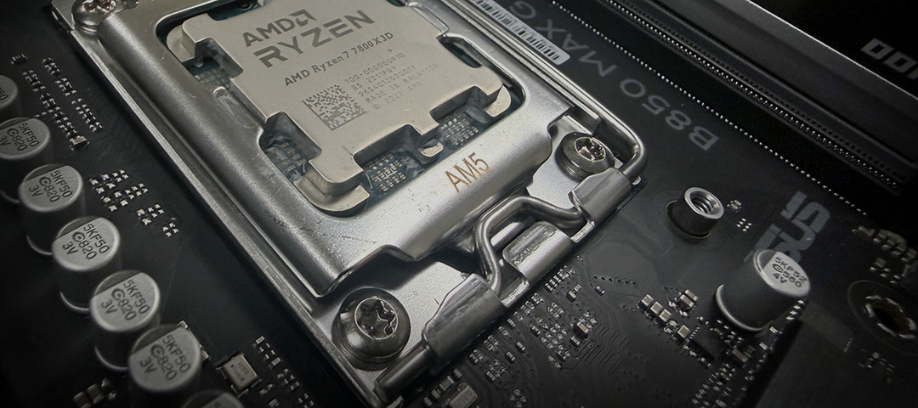
AMD’s Ryzen X3D processor line illustrates how far this architectural shift has progressed. These chips incorporate a technology called 3D V-Cache, which physically layers additional cache memory directly onto the processor die — dramatically increasing the volume of data that can be stored immediately adjacent to the processing cores.
Anthony Van Kline, NA Gaming Marketing Manager at AMD, described the operational benefit: “With extra cache stacked directly on top of the processor, the CPU doesn’t have to access the system RAM as much because more can be stored closer to where it’s needed, which results in smoother gameplay, higher frames per second, and less waiting.”
In performance benchmarks, the gap between single-channel and dual-channel memory on X3D-equipped systems narrows to less than 2% across most typical workloads — well within normal session-to-session performance variation. For procurement teams, this means that deploying a single higher-quality memory module on an X3D platform is a defensible choice, not a compromise, and it preserves a straightforward upgrade path as market conditions evolve. [³]
Platform Integration as a Competitive Advantage
Beyond memory architecture, there is a broader strategic argument for considering integrated hardware ecosystems. AMD produces both processors and discrete graphics cards, and when the two are paired, a feature called Smart Access Memory becomes available. This capability allows the CPU and GPU to access each other’s memory resources more freely, removing a common data transfer bottleneck and lifting performance without any change to the underlying hardware specification.
Hoang noted the business case clearly: “AMD is one of the few brands that has a complete ecosystem across GPU and CPU. With their software, they can better optimise how the two are being used together and move workloads between processor and graphics card dynamically. It’s better utilisation because they understand each other in a way that chipmakers without that full-stack relationship simply can’t match.”
For technology buyers evaluating total cost of ownership rather than component costs in isolation, this kind of platform-level optimisation can translate into measurable performance gains from existing hardware spend. [⁴]
What This Means for Technology Buyers in 2025
The memory market has shifted structurally, not cyclically. AI infrastructure investment has redirected manufacturing capacity at scale, and that capacity cannot be rebuilt quickly. Organisations that continue to specify hardware based on assumptions formed five or ten years ago risk overspending on memory configurations that deliver no measurable operational benefit.
The more productive approach is to assess workloads honestly, take advantage of architectural improvements in modern processors, and consider platforms where hardware integration delivers efficiency gains that component-level purchasing cannot. In a market where every procurement decision is under scrutiny, the organisations that adapt their technology strategy to current market realities will be better positioned than those defending conventions that the hardware has simply outgrown.
References
- TechRadar — RAM prices expected to rise further in 2025 due to AI demand: https://www.techradar.com/news/ram-prices-rising-ai
- Tom’s Hardware — Single vs Dual Channel Memory: How Much Does It Matter Today?: https://www.tomshardware.com/features/single-vs-dual-channel-ram
- AnandTech / AMD Official — AMD Ryzen X3D 3D V-Cache Architecture Overview: https://www.amd.com/en/products/processors/ryzen
- AMD — Smart Access Memory Explained: https://www.amd.com/en/technologies/smart-access-memory
This article was produced by the Cyprus Business Group editorial team. Views expressed reflect market analysis and do not constitute procurement advice. For tailored technology strategy guidance, contact the CBG Business Technology desk.



0 Comments