


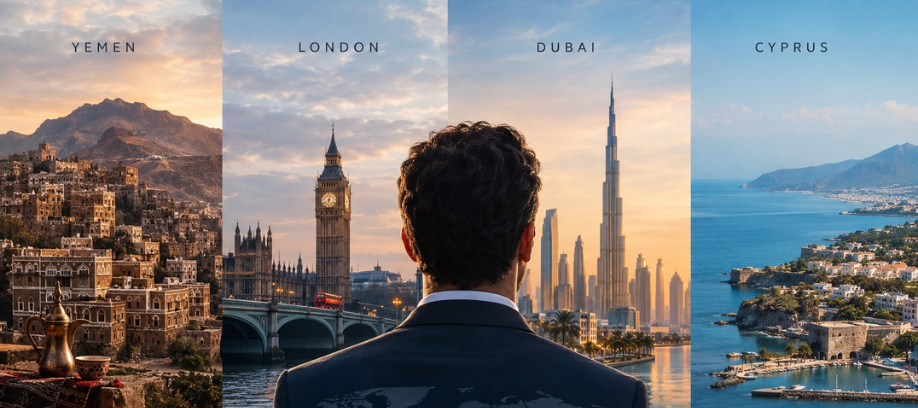
What Yemen, London, Dubai and Cyprus Taught Me About Trust, Leadership and Sustainable High Performance
By Hassan M. Al-Shohaty
In international business, success is often measured by how much we achieve. But after more than 15 years in finance, working across different cultures and business environments, I discovered that the most effective leaders are not necessarily those who do more. They are those who understand when to do less.
Where Leadership Begins
I was born and raised in Yemen, a country that is often misunderstood by those who have never experienced it.
When I first met my wife in London in 2010, she had no idea where Yemen was. After a quick Google search, she discovered headlines associated with terrorism and conflict. Fortunately, we ended up getting married, so I like to think the real Yemen made a better impression than Google did.
The Yemen I remember growing up in was very different from the image often presented internationally.
It was a place where hospitality, respect, loyalty and human connection were fundamental to everyday life. People looked after one another, and your reputation mattered more than almost anything else.
In Yemen, your reputation is your currency.
My father embodied that philosophy.
He was a respected leader within our tribe and the political landscape, but what made him a leader in my eyes wasn’t his position. It was how he treated people.
Members of our tribe would arrive at our home unannounced, and he would always welcome them. They would join us for meals, and he would personally help them whenever he could.
I remember a cousin once asking him for a recommendation for a job. My father asked me to bring him his official paper, wrote the recommendation by hand and signed it. He then explained to our cousin whom to approach and how to present himself.
But my father would only put his name behind someone whose character he genuinely trusted.
That experience stayed with me.
Long before I understood corporate leadership, I understood that leadership was about responsibility, integrity and helping others.
My father taught me to be the leader I wished I had.
Four Places, Four Leadership Lessons
When I moved to London to study at Queen Mary, University of London, I entered a completely different environment.
I had travelled internationally with my parents while growing up, so I didn’t experience the culture shock that many international students described.
What struck me most was how differently people interacted.
In Yemen, relationships and personal connections were central to everyday life. In London, people often seemed more disconnected. On the Underground, commuters kept to themselves, reading newspapers or listening to music.
But London taught me something equally valuable: the importance of execution.
Working in the City meant operating in an environment where punctuality, efficiency and quick decision-making were essential.
During my time at Bloomberg, covering Middle Eastern equities, I witnessed a particularly memorable example of leadership.
As Dubai’s real estate debt crisis made international headlines, one of the firm’s global leaders came to our desk, stood alongside us and offered his support.
He didn’t arrive to criticise or take control. He wanted us to know that we had the support needed to navigate a difficult situation.
That moment reinforced something I had learned from my father: leadership is demonstrated through actions, particularly when circumstances become challenging.
My next chapter took me to Dubai, where I joined Morgan Stanley’s Middle Eastern desk.
Dubai in 2010 was recovering from the Global Financial Crisis, and professionals from around the world were contributing to its economic revival.
It was a fascinating international business environment, but one particular experience changed my understanding of inclusive leadership.
On our trading floor, Arabic was frequently spoken. It was natural for many of us, but not everyone understood the language.
During a visit from London, my supervisor pointed this out.
She explained that by speaking Arabic in a shared professional environment, we were unintentionally excluding colleagues who couldn’t understand us.
It was a simple observation, but an important lesson.
For the first time, I began thinking more deeply about inclusion—not as a corporate policy, but as a leadership responsibility.
When we work across borders, we cannot assume that what feels natural to us will work equally well for everyone.
Eventually, my journey brought me to Cyprus.
Geographically and culturally, Cyprus felt like a meeting point between the Middle East, where I grew up, and the United Kingdom, where I studied and began my career.
What impressed me most was the people.
During my time at PwC, I worked with professionals who were focused, efficient and hardworking, while still maintaining a strong appreciation for family, relationships and enjoying life.
Cyprus seemed to combine London’s ability to get things done with the warmth and personal connection I had experienced growing up.
Looking back, each place contributed something different to my understanding of leadership.
Yemen taught me integrity and human connection. London taught me execution. Dubai taught me inclusion. And Cyprus helped me bring those lessons together.
Trust Is the Currency of International Business
Having lived and worked across different countries, I have learned that business environments may change, but certain principles remain universal.
Trust is one of them.
Technology is evolving at an extraordinary pace. Businesses are becoming increasingly international, and professional relationships are often developed without people ever meeting face-to-face.
Yet trust remains fundamental.
During my years in private banking, I worked with some of the world’s largest financial institutions.
Their names carried enormous weight and opened doors.
But I quickly discovered that while a respected institution might secure an introduction, it was the individual relationship that determined whether a client would place their trust in us.
At Credit Suisse, part of my responsibility involved helping clients open accounts, which required close collaboration with compliance teams.
Many ultra-high-net-worth individuals, particularly in the Middle East, were extremely private.
They would only share sensitive information when they felt genuinely comfortable with the person sitting across from them.
That experience reinforced a principle I still follow today.
Trust is difficult to earn and remarkably easy to lose.
I often compare it to glass. It takes time to make, but only a second to break. Even when you put it back together, the cracks remain visible.
Today, approximately 80% of my coaching business operates online, allowing me to work with clients internationally from Cyprus.
Despite the geographical distance, my approach has not changed.
I protect the information clients share with me, respect their confidence and recognise that my reputation is one of my most valuable assets.
That is something I learned growing up in Yemen.
For leaders operating internationally, cultural awareness matters. Communication styles, expectations and professional customs may differ significantly between markets.
But regardless of geography, sustainable business relationships begin with trust.
When Success Becomes Unsustainable
After more than 15 years in investment advisory, I reached what many people would consider the height of a successful corporate career.
I was Head of Independent Investment Advisory at PwC Investment Services in Cyprus.
Our department was growing. My team was performing. From the outside, everything appeared to be going well.
But internally, I was struggling.
I had developed a belief that achieving more required doing more.
I accepted almost everything that came my way. I worked up to 14 hours a day, micromanaged my team and frequently took back responsibilities I had already delegated.
I avoided difficult conversations and rarely admitted when things were becoming overwhelming.
The more successful our department became, the further I felt from that success.
Instead of recognising the warning signs, I pushed harder.
I worked longer hours, woke up earlier and went to sleep later.
My body was sending signals that something needed to change. I was becoming ill almost every month, but I continued to ignore them.
I had confused being busy with being effective.
In March 2022, everything changed.
I contracted COVID-19 and isolated myself in a room away from my wife and our two daughters.
Even while shivering with a fever, I opened my laptop and attempted to work.
Eventually, colleagues from Human Capital told me to log off completely and take the time I needed to recover.
The idea of being away from work for two weeks felt almost impossible.
But I had reached a point where I simply couldn’t continue.
For the first time in years, I stopped.
And in that silence, I began questioning what I had been working so hard to achieve.
The Moment Everything Changed
During my isolation, I had one of the most profound experiences of my life.
One evening, I decided to meditate and ask myself a question that had been on my mind for years.
What is my purpose?
After approximately 40 minutes of uninterrupted silence, one word appeared clearly in my mind.
SOLVE.
I didn’t understand what it meant.
Until then, I had always believed my purpose was to serve others.
The following morning, while searching YouTube for something to watch, I came across an episode of The Diary of a CEO featuring Mo Gawdat, a former Google executive.
He spoke about his professional achievements, his personal journey and the tragic loss of his son.
He also discussed the book he had written.
Its title was Solve for Happy.
There was that word again.
Solve.
For me, it became an invitation to reconsider everything.
I began asking myself whether the life I had built reflected the person I wanted to become.
I realised that my professional achievements were not aligned with how I wanted to live or lead.
Something needed to change.
After recovering, I began exploring that change through courses, assessments and a deeper understanding of my own strengths and motivations.
Eventually, I discovered executive coaching.
It brought together my professional experience, my understanding of leadership and something that had always mattered to me: helping people become better versions of themselves.
Most importantly, I replaced the belief that had driven much of my career with a completely different philosophy.
High performance is about doing less, not more.
Redefining High Performance
International leaders today face extraordinary demands.
They manage multicultural and multigenerational teams, navigate economic uncertainty and adapt to technological developments that are changing how businesses operate.
Artificial intelligence is transforming industries, while remote and hybrid working arrangements require new approaches to communication, accountability and collaboration.
Under these circumstances, it can be tempting for leaders to become more controlling.
I understand that temptation because I have experienced it myself.
When we feel responsible for results, we often believe we need to oversee everything.
But control is not the same as leadership.
Consider a manager responsible for a remote team.
They may wonder whether employees are working effectively when nobody is physically supervising them.
The instinct might be to introduce more reporting, more meetings and more oversight.
But that approach can create dependency rather than accountability.
A better starting point is trust.
We hire people because they demonstrate the skills, attitude and character needed to contribute.
Leadership involves understanding how individuals work best, giving them the conditions to succeed and trusting them to deliver.
Of course, trust works both ways.
Employees must honour the responsibility placed in them, just as leaders must demonstrate that they deserve their teams’ confidence.
The same principle applies to technology.
Artificial intelligence can be a valuable tool when used appropriately.
Some professionals are advanced users, others are still exploring its possibilities, and some have barely begun.
Leaders need to understand where their teams stand and identify how technology can support their work.
If AI can handle repetitive tasks, people can spend more time on activities requiring creativity, judgement and human connection.
That is a practical example of doing less to achieve more.
Great Leaders Create More Leaders
One of the most important lessons I have learned is that leadership is not about becoming the person who has every answer.
It is about developing people who can find answers themselves.
When a leader constantly provides instructions, the team can become dependent on that individual.
Every challenge requires approval. Every uncertainty leads to another question.
The leader becomes increasingly busy, while the team’s ability to operate independently remains limited.
Coaching offers a different approach.
Instead of immediately providing solutions, leaders can ask better questions.
They can encourage their teams to think critically, explore alternatives and take ownership of decisions.
This may require more patience initially.
But over time, it develops confidence, capability and accountability.
There is a Greek proverb about the greatness of a society being reflected in people who plant trees knowing they may never sit in their shade.
I believe the same applies to leadership.
The strongest leaders invest in developing others, even when they may never personally benefit from the results.
Their success is reflected not only in what they achieve, but in what others become because of them.
For me, sustainable high performance means fewer unnecessary instructions, less micromanagement and greater accountability.
It means creating an environment where people can perform without sacrificing their wellbeing.
And it means understanding that balance is not necessarily an equal division between professional and personal life.
Balance changes depending on our circumstances.
What matters is being fully present in whatever we are doing and communicating openly with the people around us.
Cyprus Doesn’t Need to Become the Next London or Dubai
Having experienced different international business environments, I believe Cyprus has a distinctive opportunity.
London and Dubai have established themselves as major business centres, but they achieved that position through different approaches.
London has a long history as an international financial and economic hub.
Dubai has developed an extraordinary global presence within a much shorter period, supported by a clear vision and the collective ambition of its leadership and residents.
Both offer valuable lessons.
But I don’t believe Cyprus needs to become the next London or the next Dubai.
Its opportunity is to build on what makes it different.
Cyprus has a strategic geographical position between Europe and the Middle East, a convenient time zone, membership in the European Union and a business environment where English is widely spoken.
These are important advantages.
But what stands out to me most is something less easily measured.
Its way of life.
I remember visiting Cyprus for the first time and noticing how many people were living well into their nineties.
I also remember driving through the island on a Wednesday afternoon and seeing people sitting in cafés, playing cards and enjoying one another’s company.
That image stayed with me.
Here was a community that understood the importance of connection, family and enjoying life.
Perhaps Cyprus understood the value of doing less long before I did.
In an international business environment where professionals increasingly struggle with pressure, exhaustion and the constant demand to achieve more, this balance represents a meaningful advantage.
Cyprus can demonstrate that professional ambition and quality of life do not need to exist in opposition.
The challenge is to preserve that identity while continuing to grow internationally.
And that responsibility doesn’t belong exclusively to the government.
It belongs to all of us who have chosen to live, work and build businesses here.
Cyprus is my home now, and I believe we all have a role in contributing to its future.
Leadership Begins Within
When I reflect on my journey from Yemen to London, Dubai and Cyprus, I see how every experience contributed to the leader and coach I have become.
My father taught me that leadership begins with character.
London showed me the importance of execution.
Dubai taught me to recognise the people who might otherwise be excluded.
Cyprus reminded me that achievement means little if we lose our ability to enjoy the life we are building.
And my own experience with burnout taught me perhaps the most important lesson of all.
Success should not come at the expense of ourselves or the people around us.
The future of international business will undoubtedly involve more technology, more complexity and more change.
But I believe the leaders who thrive will be those who remain grounded in the principles that have always mattered: trust, integrity, human connection and the ability to bring out the best in others.
True high performance is not about how much we can carry.
It is about recognising what matters, creating space for others to grow and understanding when enough is enough.
Because sometimes, the most powerful thing a leader can do is less.
in this article clear the formating no any rewords or rewriteing make the sub headers bolt




0 Comments