


Todoist Introduces Voice-Driven Task Creation
You may not need an AI-powered smart ring to stay on top of your daily tasks. Doist, the company behind the cross-platform productivity app Todoist, has unveiled a new AI-enabled feature called Todoist Ramble, designed to convert spoken thoughts into structured to-do items.
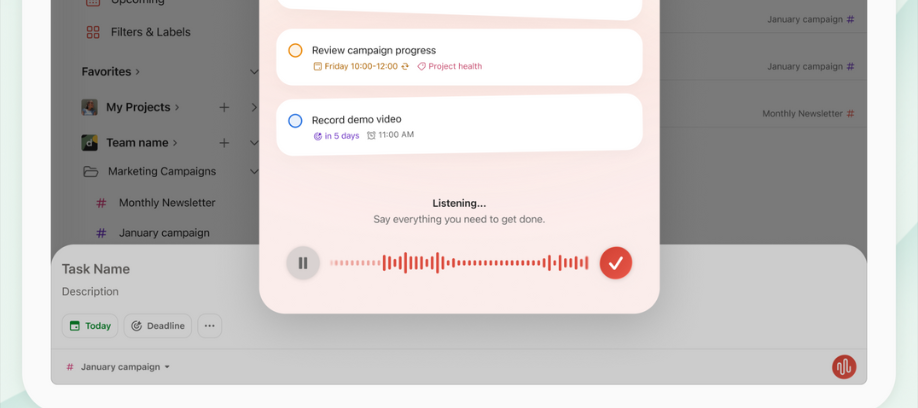
The new tool allows users to describe tasks naturally, using their voice, without worrying about structure or formatting. Ramble processes unstructured speech and transforms it into organised tasks within Todoist.
Turning Natural Speech into Structured To-Dos
As its name suggests, Ramble is built to handle free-flowing, sometimes meandering speech. The feature automatically extracts and organises key information such as deadlines, priorities, task duration and assignees.
The functionality targets moments when users think of tasks while on the move, but find typing inconvenient. Instead of writing anything manually, users can tap the Ramble icon and begin speaking. As they talk, the app updates the task in real time, responding to edits or clarifications as they are spoken.
According to Doist, users can even make adjustments mid-sentence by saying phrases such as “Actually, make that Thursday” or “that’s all” to guide the AI as it processes the input.
Powered by Large Language Models
Ramble is built using large language models (LLMs) and forms part of a broader AI toolkit branded as Todoist Assist. The system runs on Google’s Gemini 2.5 Flash Live model through Vertex AI, enabling real-time speech recognition and task generation.
As audio is streamed to the backend, the model transcribes the speech and identifies tasks, dates and other contextual details before generating structured to-do items.
Doist states that audio is not stored or used for AI training, and that the app is SOC2 Type II certified, reinforcing its focus on data privacy and security.
Part of a Wider AI Productivity Trend
Todoist’s new feature mirrors a growing trend across AI-enabled hardware and software designed to convert speech into actionable insights. Devices such as Amazon’s Bee wearable use AI to capture notes and suggest tasks, while products from Plaud focus on meeting transcription and summarisation.
Interest is also increasing in AI-powered smart rings, including the Stream ring by startup Sandbar and Pebble’s upcoming Index 01 ring. These devices allow users to press the ring to quickly record notes or add tasks through a companion mobile app.
Strong Early Adoption During Beta Testing
Ahead of its public release, Ramble was tested by Todoist Experimental users, a group of approximately 150,000 active testers who receive early access to new features.
Within the first three weeks of beta testing, around 76,000 users completed roughly 290,000 Ramble sessions across desktop and mobile platforms. The feature then moved into public beta testing in November.
Doist reports that task creation success rates increased from around 40% in October to approximately 62% by December. The company also says Ramble contributed to higher conversions, with new users on the entry-level plan upgrading at a rate roughly five times higher than before using the feature.
Availability and Pricing
Todoist Ramble is now available to all users across iOS, Android, desktop and web, supporting 38 languages. Users on the Beginner plan can access the feature with a limited number of sessions per month, while Pro and Business plans offer unlimited usage.
For convenience, Ramble can be launched via Home Screen or Lock Screen shortcuts on iOS, as well as through app shortcuts, widgets and quick settings tiles on Android.



0 Comments